Bert Blevins is a distinguished technology entrepreneur and educator who brings together extensive technical expertise with strategic business acumen and dedicated community leadership. He holds an MBA from the University of Nevada Las Vegas and a Bachelor’s degree in Advertising from Western Kentucky University, credentials that reflect his unique ability to bridge the gap between technical innovation and business strategy.
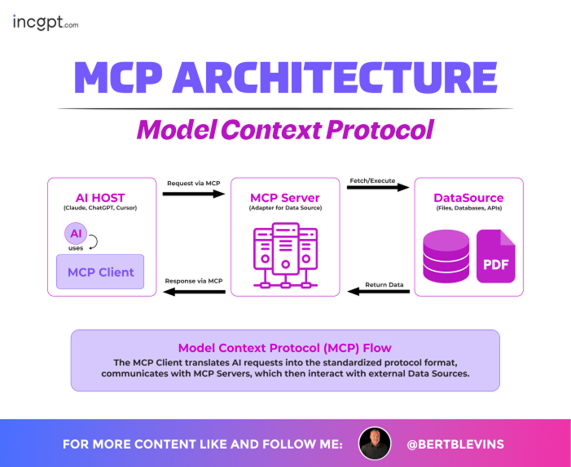
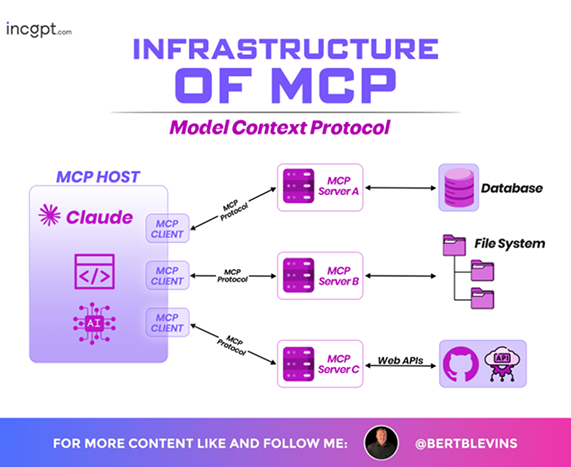
The Model Context Protocol (MCP) architecture is a system designed to facilitate communication between MCP Hosts (such as Claude Desktop, IDE, and AI Tools) and various data sources including local filesystems, databases, and the internet. MCP Clients act as intermediaries, sending requests to MCP Servers, which process and fetch data from these sources, ensuring seamless interaction. The key components section highlights the MCP Client and Server, supported by transport layers, and includes features like notifications, sampling, tools, resources, and prompts.
The overview presents a step-by-step guide to building a custom MCP (Model Context Protocol) Server using Python, detailing the MCP architecture where MCP Clients interact with an MCP Server via the MCP Protocol to access resources like databases, services, and files. It outlines the process starting with setting up the development environment using MCP Python SDK, FastMCP, AsyncIO, and Requests, followed by creating a basic server structure and developing.
The MCP (Model Context Protocol) workflow showcases how various AI models and agents, including OpenAI, Claude, Deepseek, CrewAI, LangChain, LangGraph, CopilotKit, and Llamaindex, interact with the MCP to access a range of tools and data sources. These tools and data sources encompass GitHub, SingleStore, Slack, Zendesk, Snowflake, Drive, and Dropbox, enabling seamless integration and data processing.

The Model Context Protocol (MCP) architecture overview illustrates how MCP Clients within Agent A and Agent B (MCP HOSTs) communicate with multiple MCP Servers (A, B, C, Y, Z) using the MCP Protocol. It highlights secure collaboration, task and state management, UX negotiation, and capability discovery facilitated by the A2A Protocol between agents. The MCP Servers connect to various data sources, including Local Data Sources 1 and 2, and Internet Web APIs, enabling data access and interaction.
Bert Blevins is a distinguished technology entrepreneur and educator who brings together extensive technical expertise with strategic business acumen and dedicated community leadership. He holds an MBA from the University of Nevada Las Vegas and a Bachelor’s degree in Advertising from Western Kentucky University, credentials that reflect his unique ability to bridge the gap between technical innovation and business strategy.
The Model Context Protocol (MCP) architecture is a system designed to facilitate communication between MCP Hosts (such as Claude Desktop, IDE, and AI Tools) and various data sources including local filesystems, databases, and the internet. MCP Clients act as intermediaries, sending requests to MCP Servers, which process and fetch data from these sources, ensuring seamless interaction. The key components section highlights the MCP Client and Server, supported by transport layers, and includes features like notifications, sampling, tools, resources, and prompts.
The overview presents a step-by-step guide to building a custom MCP (Model Context Protocol) Server using Python, detailing the MCP architecture where MCP Clients interact with an MCP Server via the MCP Protocol to access resources like databases, services, and files. It outlines the process starting with setting up the development environment using MCP Python SDK, FastMCP, AsyncIO, and Requests, followed by creating a basic server structure and developing.
The MCP (Model Context Protocol) workflow showcases how various AI models and agents, including OpenAI, Claude, Deepseek, CrewAI, LangChain, LangGraph, CopilotKit, and Llamaindex, interact with the MCP to access a range of tools and data sources. These tools and data sources encompass GitHub, SingleStore, Slack, Zendesk, Snowflake, Drive, and Dropbox, enabling seamless integration and data processing.
The Model Context Protocol (MCP) architecture overview illustrates how MCP Clients within Agent A and Agent B (MCP HOSTs) communicate with multiple MCP Servers (A, B, C, Y, Z) using the MCP Protocol. It highlights secure collaboration, task and state management, UX negotiation, and capability discovery facilitated by the A2A Protocol between agents. The MCP Servers connect to various data sources, including Local Data Sources 1 and 2, and Internet Web APIs, enabling data access and interaction.